Authentic attar from master perfumers of Kannauj. Rose, oud, sandalwood, and jasmine blends. No alcohol, 100% natural oils. Wholesale from ₹190.
Attar (also spelled "ittar" or "atar") is a concentrated essential oil extract made through hydrodistillation—a centuries-old process that captures the pure aromatic essence of flowers, woods, and plants without any chemical solvents or alcohol.
Unlike conventional perfumes that contain 5-20% fragrance oils mixed with alcohol, attar is 100% pure essential oil. A single drop delivers hours of fragrance on your skin. The hydrodistillation process heats botanical materials with water vapor, condenses the aromatic compounds, and separates them from water in a traditional copper still. This method has remained unchanged for over 1,000 years, perfected in the perfume heartland of Kannauj, Uttar Pradesh.
The result is a liquid that is intensely fragrant, longer-lasting, and more faithful to the natural scent profile than synthetic fragrances. Attar doesn't evaporate like alcohol-based perfume; it gradually unfolds on your skin over 6-12 hours, with top notes, heart notes, and base notes developing naturally.
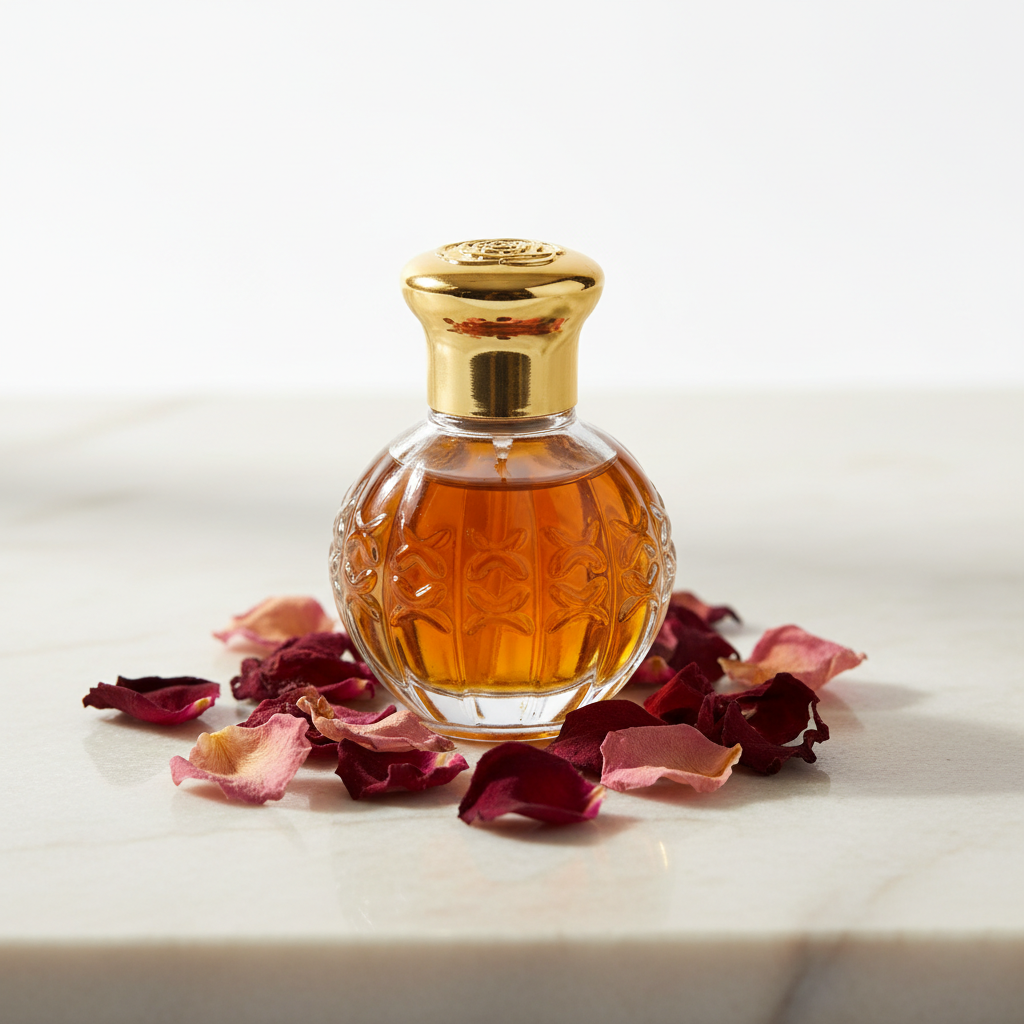
Floral Attars are the most popular category. Rose attar (gulab) is the classic—deep, romantic, and complex. Jasmine attar (chameli) offers a heavier, more intoxicating floral profile, while mogra (jasmine sambac) is lighter and more delicate. These are traditionally worn during the day or in cooler months when florals shine.
Woody Attars come primarily from sandalwood and oud. Sandalwood attar (chandan) from Mysore is creamy, warm, and universally wearable—it pairs with both floral and spicy notes. Oud attar is the most luxurious and expensive, derived from agarwood infected with a specific mold. Oud smells deeply woody with hints of leather, earth, and honey. Cedarwood attar provides a sharper, drier woody profile.
Earthy Attars capture mineral, soil, and plant-based scents. Mitti attar (petrichor) captures the exact smell of rain on dry earth—perfect for monsoon months. Vetiver attar offers a grassy, smoky earthiness with slight sweetness. These are often underrated but deeply comforting to experienced attar wearers.
Musky Attars provide warm, sensual base notes that linger on skin and clothing. White musk attar is synthetic but creates a soft, skin-like scent. Animal musks (musk deer, civet) are now banned for ethical and legal reasons. Musk works best layered with florals or applied to pulse points for evening wear.
Compound Attars (Majmua) blend multiple essential oils and absolutes into complex, signature fragrances. Majmua 96, for instance, contains 96 different ingredients and is considered a masterpiece of blending. These custom blends cannot be recreated exactly twice and represent the artistry of master perfumers.
Attar is not applied like conventional perfume. Because it has no alcohol carrier, it concentrates on skin and doesn't have a "spray dispersal zone." Instead, apply attar to pulse points: inside wrists, behind ears, inner elbows, and base of throat. These warm areas help the fragrance develop and project naturally.
Use only 1-2 drops per application. Attar is highly concentrated; more isn't better. A single drop on each wrist and behind each ear (4 drops total) is a full day's fragrance for most people. You can refresh by adding a drop to your inner wrists mid-day.
Layering is an advanced technique. Apply a lighter floral attar first (rose or jasmine), then top it with a woody attar (sandalwood or oud) for complexity. Your skin chemistry will blend them naturally over 30 minutes.
For clothing, apply 1-2 drops to the inside of your collar, chest, or hem. Attar stains delicate fabrics, so avoid silk unless you're certain. The fragrance will last 2-3 washings on cotton.
Seasonal wearing: Rose, jasmine, and mogra are fresh and floral—ideal for spring and summer. Sandalwood and cedarwood work year-round. Oud, musk, and vetiver are for fall and winter, evening wear, or special occasions. Mitti attar is sacred to monsoon months.
Proper storage is critical because attar degrades in light and heat. Always store attar in dark glass bottles (amber or cobalt)—never clear glass. Keep bottles in a cool, dark place: a bathroom cabinet, bedroom drawer, or pantry. Never store in a kitchen (heat from cooking) or bathroom with high humidity.
The ideal temperature range is 15-25°C (59-77°F). Avoid refrigerators (condensation risks) and never freeze. Keep caps tightly sealed to prevent evaporation. Quality attar can last 5-10 years when stored properly; poorly stored attar may degrade within months.
Transfer attar to a roller bottle or small atomizer only if you'll use it within 6 months. Metal and plastic containers can interact with attar compounds over time; glass is always safest.
Price is often a reliable indicator. Genuine attar costs money. Rose attar should cost at least ₹300-500 per 10ml bottle. If you see rose attar for ₹50, it's either extremely diluted with mineral oil or contains little actual attar. Oud attar, by contrast, should cost ₹800-2000 per 10ml minimum—genuine Assam oud can be ₹3000+.
Color matters. Rose attar is dark brown or amber—never clear or pale yellow. Jasmine is brown or reddish-brown. Sandalwood is pale gold or honey-colored. Oud ranges from dark brown to black. If the color seems off, the attar may be adulterated.
Smell test: Genuine attar has a rich, complex scent that develops over 5-10 minutes on skin. If it smells sharp, chemical, or exactly the same throughout the day, it's probably a synthetic fragrance marketed as attar. True attar reveals different notes over time.
Patch test: Dab a tiny amount on your inner arm and wait 30 minutes. Genuine attar will feel oily, smell strong, and last several hours. Synthetic fragrance will feel watery, dry quickly, and fade fast.
Seller transparency: Reputable sellers specify which botanical is used (e.g., "Damask Rose," "Mysore Sandalwood," "Assam Oud"), the production method, and batch information. Vague descriptions like "premium attar" without specifics are red flags.
Why prices vary: The botanical source matters enormously. Damask rose (Bulgaria/India) costs more than centifolia rose. Mysore sandalwood is more expensive than other varieties because of limited supply and superior quality. Assam oud is more expensive than Middle Eastern oud because of rarity. Master perfumers' custom blends cost more because they represent years of expertise.
Spring (March-May): Light floral attars—rose, jasmine, mogra, and floral blends. These feel fresh and romantic as weather warms. Avoid heavy orientals and oud.
Summer (June-August): Citrus-based blends if available, or go light with jasmine. Mitti attar is perfect during monsoon (June-July) to capture the season's essence. Sandalwood works year-round but feels best in moderate temperatures.
Monsoon (July-September): Mitti attar is sacred—its petrichor scent matches the season perfectly. Vetiver is another earthy choice. Avoid heavy musks that can feel cloying in humidity.
Fall (September-November): Transition to warmer notes—sandalwood, woody blends, and light oud. Spicy or spiced floral blends start feeling appropriate.
Winter (December-February): Oud, musk, deep florals, and complex blends. This is oud season. Heavier fragrances project better in cold weather and feel comforting in layers.
Evening wear: Oud, musk, sandalwood, and deep florals. These are richer, longer-lasting, and more sophisticated. Morning wear is lighter florals and woodsy options.
Office/casual: Sandalwood, light rose, mogra, or unisex blends. Avoid overpowering oud or heavy musks—professional settings call for restraint.
Verified supply chain from master perfumers in India's attar capital. No middlemen, authentic sourcing, traceable ingredients.
Lab-tested purity certificates. Every batch verified for fragrance concentration and chemical composition. Written guarantee included.
Buy 1 bottle or 1,000. Flexible MOQs starting from single units. Bulk pricing tiers available for retailers, hotels, spas.
Hand-selected by fragrance specialists with 20+ years of attar knowledge. Personalized recommendations via WhatsApp.
Start with your skin chemistry. Everyone's skin is different—some people are "warm" (darker, oily skin naturally projects fragrance further), while others are "cool" (paler, drier skin). Warm skin chemistry usually suits woody and musky attars well. Cool skin chemistry often prefers florals. Test on the inside of your wrist and wait 30 minutes to see how the fragrance develops on your specific skin.
Consider your mood and season. Do you want something fresh and uplifting (jasmine, rose, mogra)? Something warm and sensual (oud, musk, sandalwood)? Something grounding and earthy (mitti, vetiver)? Match your mood to the attar family. In summer, light florals feel better; in winter, heavy orientals feel more appropriate.
Test before committing to larger quantities. Our gift set includes 5 different 3ml samples—this is the perfect way to explore. Wear each one for a full day and notice which you return to, which gets compliments, and which feels "right" on your body.
Budget matters, but pure attar is an investment. If you're new to attar, start with Rose (₹450), Sandalwood (₹680), or Majmua 96 (₹335). These are excellent quality at mid-range prices. Once you understand your preferences, invest in Oud (₹1,200) or specialty blends. You use only 1-2 drops per day, so a 10ml bottle lasts 2-3 months—₹450/12 weeks = ₹37/week, less than a coffee.
Don't just smell the cap. Many people make the mistake of smelling attar directly from the bottle. The scent is overwhelming and unrepresentative. Always dab a tiny amount on your wrist and wait 5 minutes before deciding. Attar reveals itself gradually.
Fragrance concentration: Attar is 100% essential oil with 0% alcohol or additives. Conventional perfume (eau de parfum) contains 15-20% fragrance oil plus 80-85% alcohol and water. Eau de toilette is only 5-10% fragrance. This difference is critical.
Longevity: A single drop of attar lasts 8-12 hours on skin. A spray of perfume lasts 4-6 hours. Because attar has no alcohol to "carry" the scent, it stays where you apply it—on pulse points—and gradually unfolds. Perfume disperses immediately and fades faster.
Intensity: Attar is intensely fragrant. If you're used to perfume, 1 drop of attar will surprise you with its strength. Perfume requires multiple sprays to achieve similar projection.
Skin interaction: Attar blends with your skin's natural oils, becoming more personalized and unique on each person. Perfume sits on top of the skin more as a fragrance layer. Over time (4 hours), attar actually improves as your skin chemistry enhances it. Perfume fades the same way on everyone.
Cost per wear: Attar costs more upfront (₹450-1200/10ml) but lasts 2-3 months with 1-2 drops daily. That's ₹4-10 per day. Perfume costs ₹300-800/100ml but fades faster and requires 2-3 sprays daily. That's ₹15-25 per day. Attar is actually more economical.
When to choose each: Choose attar if you want longevity, personalization, and a natural fragrance journey. Choose perfume if you prefer instant diffusion (best for entering a room), easier layering with other scents, or the ritual of spraying. Many people use both—attar as a daily personal fragrance, perfume for special occasions.
Typical longevity: 8-12 hours from a single 1-drop application, depending on several factors.
Skin type matters enormously. Oily skin holds fragrance longer—sometimes 12+ hours. Dry skin may see attar fade to a subtle presence after 6-8 hours. To extend wear on dry skin, apply attar to well-moisturized pulse points (apply lotion first, then attar). The oils in lotions help attar stick longer.
Temperature and weather: Heat accelerates diffusion. In summer heat or during physical activity, attar will fade faster (8-10 hours instead of 12). In cold weather, fragrance lingers longer because molecules move more slowly. Humidity has minimal effect on attar since it doesn't have alcohol that evaporates.
Botanical type affects wear time: Base notes (oud, sandalwood, musk, vetiver) last longest—10-14 hours. Middle notes (jasmine, rose, geranium) last 8-10 hours. Top notes (citrus, herbs) fade fastest—4-6 hours. Most attars have a blend, so you'll notice the top notes fade first (2-3 hours), then heart notes develop (3-8 hours), then base notes linger (8-12 hours).
Pulse point placement determines projection: Attar on wrists lasts longest (you reapply by touching). Behind the ears lasts 10-12 hours. Inner elbows last 8-10 hours. Inner neck/chest area lasts the full duration. For maximum wear, apply 1 drop on the inside of each wrist—that's 2 drops total, enough for a full day.
Refreshing attar: You can't "re-apply" attar like perfume. Once it dries into your skin, adding more creates a stronger layer, not an extended wear. Instead, after 6-8 hours, add 1 tiny drop to each wrist to refresh the top notes. This is entirely optional—many people enjoy the base note development in the afternoon.
Longevity on fabrics: Attar lasts 2-3 washes on cotton clothing, 4-6 weeks on hair, 6-8 washes on wool. It stains some fabrics (silk, delicate materials), so apply only to collar interiors or hidden seams.
Why oud costs what it does: Genuine oud attar is expensive (₹800-3000+ per 10ml) because agarwood is rare. Agarwood trees are infected with a specific mold (Phialophora parasitica), and only infected trees produce resin. Finding and harvesting infected trees is labor-intensive. The distillation process takes weeks. Assam oud (from India) is more expensive than Middle Eastern oud because Assam agarwood is rarer. These are the market realities—not artificial scarcity.
Is it worth buying? For most people, no. Oud is not inherently "better"—it's just different, more expensive, and polarizing. Many people find oud too heavy, woody, or overpowering for daily wear. Start with ₹280-450 attars (rose, sandalwood, musk, jasmine) to understand your preferences. If you find yourself craving deeper, woodier scents after 2-3 months, then invest in oud.
Oud quality varies wildly. A ₹300 "oud attar" online is almost certainly not genuine oud—it's likely woody-scented mineral oil. Our ₹1,200 Assam Oud is lab-certified. The difference is not subtle. If you're curious about oud but hesitant about price, try our gift set (₹699 for 5 samples)—it includes a quality oud sample (3ml) so you can experience it without committing ₹1,200.
Alternatives to pure oud: If you like the oud smell but want to save money, try Sandalwood Attar (₹680). It has similar woody depth and longevity at half the cost. Or try Oud-blended attars (oud mixed with rose or sandalwood) rather than pure oud—these cost less and are more wearable.
For collectors and enthusiasts: Yes, genuine Assam oud is worth experiencing at least once. It's a different fragrance journey—deeper, more complex, with better longevity. But it's a luxury, not a necessity. You don't need oud to have a great attar collection.
Yes, absolutely. Karvan serves both retail customers (buying 1-5 bottles) and wholesale businesses (buying 50+ bottles). Our pricing structure supports all scales.
Minimum Order Quantities (MOQ): Each product has a different MOQ based on supply and seller preference. Rose attar MOQ is 12 units, Oud is 6 units, Sandalwood is 8 units. Most products range from 5-15 unit MOQs. We can usually accommodate smaller orders for established buyers—contact us to discuss custom arrangements.
Wholesale pricing tiers:
Who benefits from wholesale: Retailers, spas, hotels, corporate gift buyers, perfume blenders, gift set assemblers, and fragrances shops. We've worked with everyone from single-shop owners to multi-location chains.
Logistics for bulk orders: We handle shipping, packaging, and labeling. For large orders (100+), we can negotiate freight costs and provide bulk discounts on packaging. Deliveries typically take 5-7 business days within India.
Payment terms: For wholesale orders, we offer net-30 and net-45 payment terms for established retailers. New sellers should contact us to discuss terms.
Custom labeling and branding: For large enough orders (200+ units), we can arrange custom labels with your business name/logo. Minimum customization run is typically 200 units. Costs depend on design complexity.
How to order: Contact us via WhatsApp with your business details, desired products, quantities, and timeline. We'll provide a formal quote with exact pricing, MOQs, and delivery timeline.
Light exposure is the biggest threat. Attar degrades when exposed to UV light. Always store attar in dark glass bottles (amber, cobalt, or dark green). Never store in clear glass bottles, plastic bottles, or metal containers. Dark glass blocks 99% of UV rays and is the only proper storage container.
Temperature stability is critical. The ideal storage temperature is 15-25°C (59-77°F). Avoid kitchens (heat from stove/oven), bathrooms near showers (humidity and temperature fluctuations), windowsills (sunlight), and cars (extreme heat). A bedroom closet, bathroom cabinet (away from shower), or pantry shelf is ideal.
Never refrigerate or freeze. Cold temperatures can cause condensation inside the bottle, introducing water to the attar and compromising it. Don't freeze—it serves no purpose for attar storage.
Keep caps tightly sealed. Attar will gradually evaporate if the cap is loose. Check that your bottle has an airtight seal. Traditional glass bottles with ground glass stoppers are best; plastic caps can degrade over time.
Avoid air exposure. Each time you open the bottle, you introduce air (oxygen) which can oxidize attar and change its scent profile. Open only when you need to apply. Using a roller bottle or atomizer for daily application is good—it keeps the main bottle sealed most of the time.
Shelf life with proper storage: Quality attar lasts 5-10 years when stored correctly. We've confirmed that 10-year-old properly stored attar smells identical to fresh attar. Poorly stored attar (in clear glass, warm locations, exposed to light) degrades within 6-12 months.
What happens when attar degrades: The scent changes—top notes disappear, the fragrance becomes flat and one-dimensional, and you may notice a slight "oxidized" or "off" smell. This doesn't mean it's unsafe to wear, just that it's past peak quality.
Transferring to smaller bottles: If you want to decant attar into a travel-size roller bottle or small atomizer, do so only if you'll use it within 6 months. Use dark glass only. The more you transfer and expose to air, the faster it degrades.
Keeping records: Note the purchase date on your attar bottle. Set a reminder to check it after 5 years. Quality attars actually improve slightly in the first 1-2 years as compounds marry, but peak around year 3-4.
Get personalized attar recommendations, bulk pricing, or custom orders via WhatsApp.